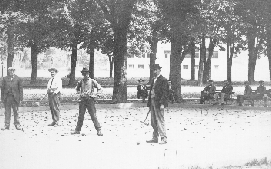
 ROQUE
ROQUEWin by points, then by contact
A game is 15 points. Make all yours first, then you win by striking your opponent's ball. Both may finish their points; the one who lands that final contact takes the game.
The American Roque League · est. 1917
the game of the century
Croquet, made scientific. Played on a hard sanded court ringed by a solid wall, with ten steel arches, two stakes, and four balls, roque rewards the bank shot, the long roquet, and a cool head. Here is its illustrated description, and its rules in full.
What the game is
Where croquet is played on open grass, roque is played inside a permanent wall you can bank the ball against, which is exactly what makes it a game of angles.
How to play
Roque rewards angles and nerve. Here is the whole game in five moves — enough to follow a match, or start one.
A game is 15 points. Make all yours first, then you win by striking your opponent's ball. Both may finish their points; the one who lands that final contact takes the game.
Each of the ten arches, taken in the right order and both directions, scores a point, as does striking the turning stake. The two center arches count as a single point.
When your ball “counts upon” a live ball, a roquet, you take play from it: set your ball against it and play a croquet stroke that moves them both.
This is what sets roque apart. The court is walled, so you may carom off the curb, a stake, or an arch. The bank shot is the whole art of the game.
With every point made you become a rover. Lay over one turn, then end the game by contacting your opponent's ball.
A few words you'll hear at the wall
The illustrated description
The scanned description pages, the court, the equipment, the strokes, and the order of play, each shown beside a faithful transcription.
Roque is an offshoot of croquet that was very popular for a time in this country. Around the turn of the century, roque clubs could be found in many cities, and the game temporarily replaced croquet as the favorite hoop-and-ball sport in America.
The major difference between roque and croquet is the roque court's raised boundaries, which allow for carom (or rebound) shots. The roque court requires less space than a croquet court, although it is somewhat more difficult to construct. The equipment needed for the two games is basically the same.
A roque court is a good idea for your backyard if your lawn is in too poor a condition to allow for a good croquet game, since the roque court is usually surfaced with clay or dirt. Or you may want to erect raised boundaries around your croquet court, and play roque on a grassy surface.
THE COURT
Roque is usually played on clay, gravel, dirt, or some other fast-playing surface, instead of grass. If there's an area of your lawn in poor condition that you'd like to cover with clay or dirt, or a sandy patch you'd care to enclose, fine. If you live in an arid part of the country—the Southwest, for instance—perhaps your yard is already surfaced with sand, clay, or dirt. Simply smooth over an area of the yard, remove all pebbles, and you'll have a ready-made roque court surface.
You could, on the other hand, use the same grassy area for a roque court that you have already set aside for a croquet court. Sprinkle gravel or sand over the turf to speed up the roll of the ball. The grass should be cut as short as possible, preferably as short as on a golf putting green.
The roque court is octagonal in shape rather than rectangular, with sixty by thirty feet the usual dimensions (Fig. 1).
Instead of the simple tape or chalk used to delineate the croquet court boundaries, the roque court must have a raised border. Wood is most often used for the border on club courts, but any relatively smooth-surfaced material will do as well.
If you have a few dozen bricks or cinder blocks handy, lay them end to end around the court. Two-by-four planks laid one on top of the other are perfect (Fig. 2). Ideally, the inside surface of the border should be faced with thin rubber, but for a home court, you needn't go to the trouble.
In short, build your border with any material that will offer a good opportunity for carom shots. And make sure the border is high enough to stop any rolling ball.
A boundary line should be marked with tape, chalk, or paint twenty-eight inches in from the raised border (Fig. 1).
The roque hoops are arranged similarly to the hoops in American lawn croquet, with the two pegs just outside the boundary line. The center wicket consists of two hoops set eighteen inches apart, their opening facing the side of the court instead of the pegs.
Note that the order in which the hoops must be run (Fig. 3) is identical to the order in American lawn croquet, but all balls…
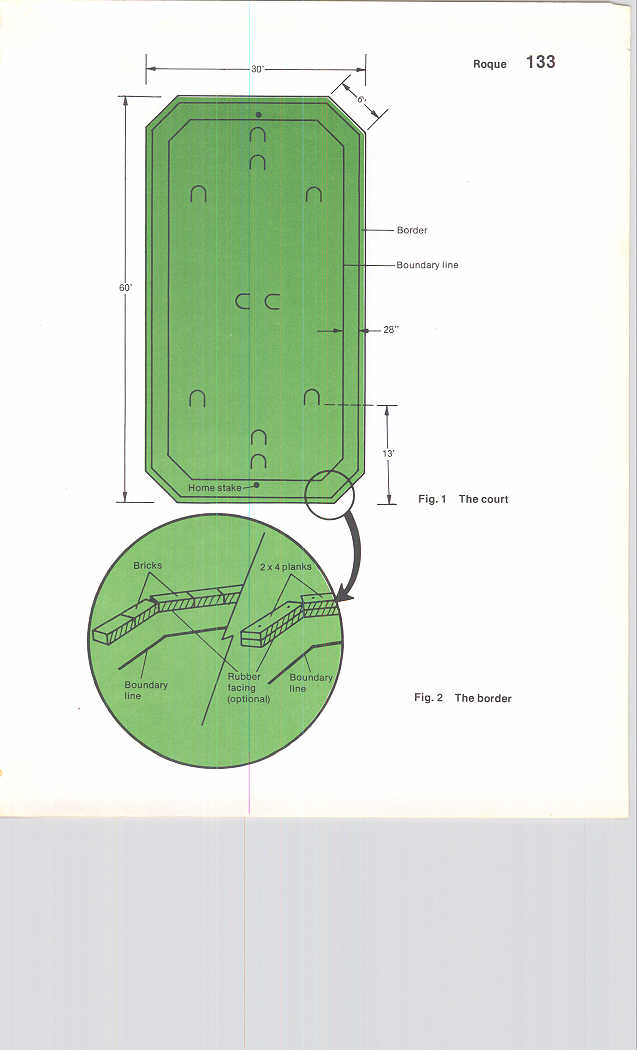
(Fig. 2 — The border.) A diagram plate: two-by-four planks laid one on top of the other, one course over the next, to build up the raised border of the court.
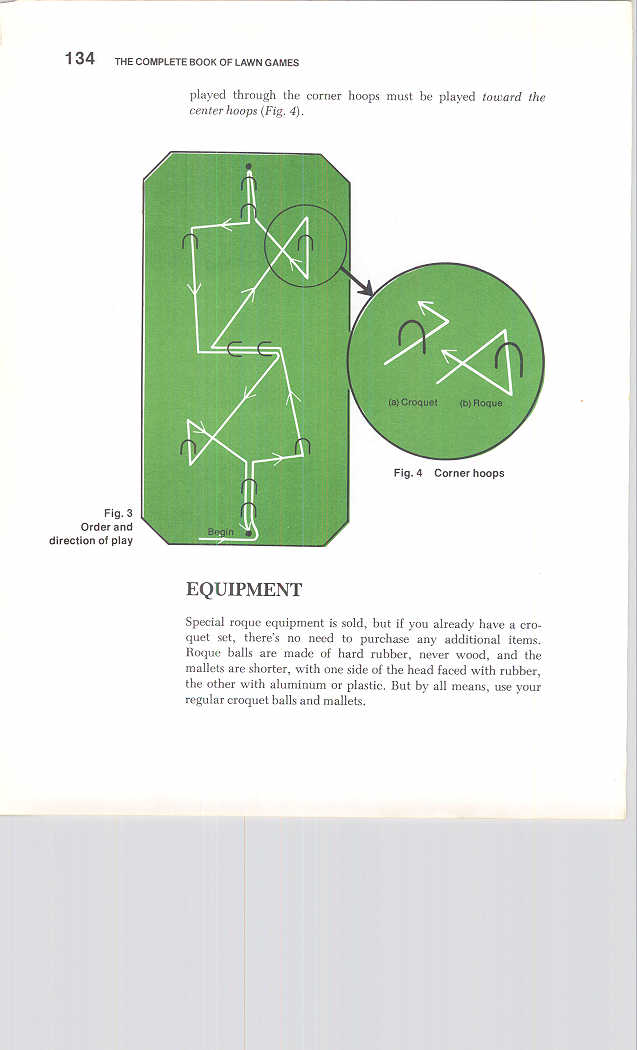
…played through the corner hoops must be played toward the center hoops (Fig. 4).
(Fig. 3 — Order and direction of play.)
EQUIPMENT
Special roque equipment is sold, but if you already have a croquet set, there's no need to purchase any additional items. Roque balls are made of hard rubber, never wood, and the mallets are shorter, with one side of the head faced with rubber, the other with aluminum or plastic. But by all means, use your regular croquet balls and mallets.
There are four colored balls (black, blue, red, and yellow or white) and matching colored clips to be affixed to the hoops as in croquet.
In official roque, the hoop openings are much narrower than in American croquet, with as little as three-and-three-quarters inches between uprights. Just try to drive a three-and-five-eighths-inch ball through a three-and-three-quarters-inch opening a few times, and you'll likely end up cracking your mallet over your knee in frustration. But there's no reason why you can't use your croquet hoops instead, with openings anywhere from five to seven inches wide.
THE PLAY
Like croquet, roque is played by either two players or two two-player teams. The rules in roque are basically the same as in croquet. The object of the game is to drive balls with a mallet through a series of hoops and against pegs in a particular order. The winning player or team is the first to complete the hoop-and-peg sequence with both team balls.
Since the rules for roque play are almost identical to croquet rules, we'll look at only those few rules that are different in roque.
In croquet, balls driven over the boundary line must be repositioned on the court. In roque, the court border is raised and carom shots are possible, as in billiards. A carom shot may even go on to score a hoop or roquet.
However, a ball that comes to rest between the raised border and the boundary line is treated as an out-of-bounds ball, and placed on the boundary line at the point where it crossed that line.
The lag: To begin the game, players “lag” for order of play and starting position.
To lag, each player places his ball on the boundary line near the home stake and drives it toward the opposite end of the court. (In a two-player game, each player lags two balls.) To qualify in the lag, the ball must not hit the border, a peg, or a hoop. The player whose qualifying ball comes to rest closest to…
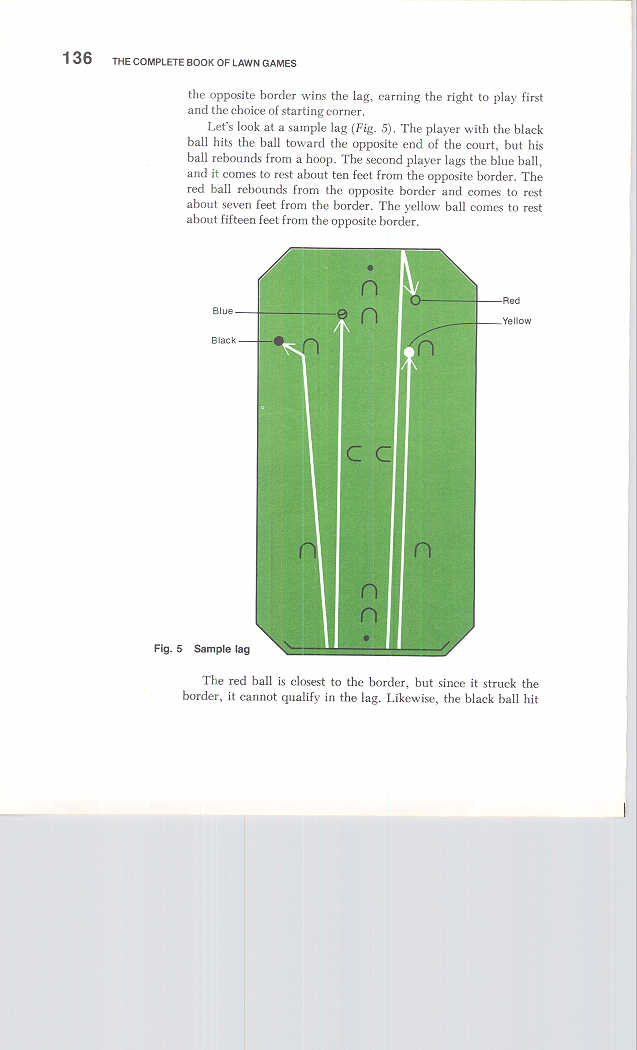
…the opposite border wins the lag, earning the right to play first and the choice of starting corner.
Let's look at a sample lag (Fig. 5). The player with the black ball hits the ball toward the opposite end of the court, but his ball rebounds from a hoop. The second player lags the blue ball, and it comes to rest about ten feet from the opposite border. The red ball rebounds from the opposite border and comes to rest about seven feet from the border. The yellow ball comes to rest about fifteen feet from the opposite border.
(Fig. 5 — Sample lag.)
The red ball is closest to the border, but since it struck the border, it cannot qualify in the lag. Likewise, the black ball hit…
…a hoop, and cannot qualify. So the blue ball is the qualifying ball closest to the border, and wins the lag.
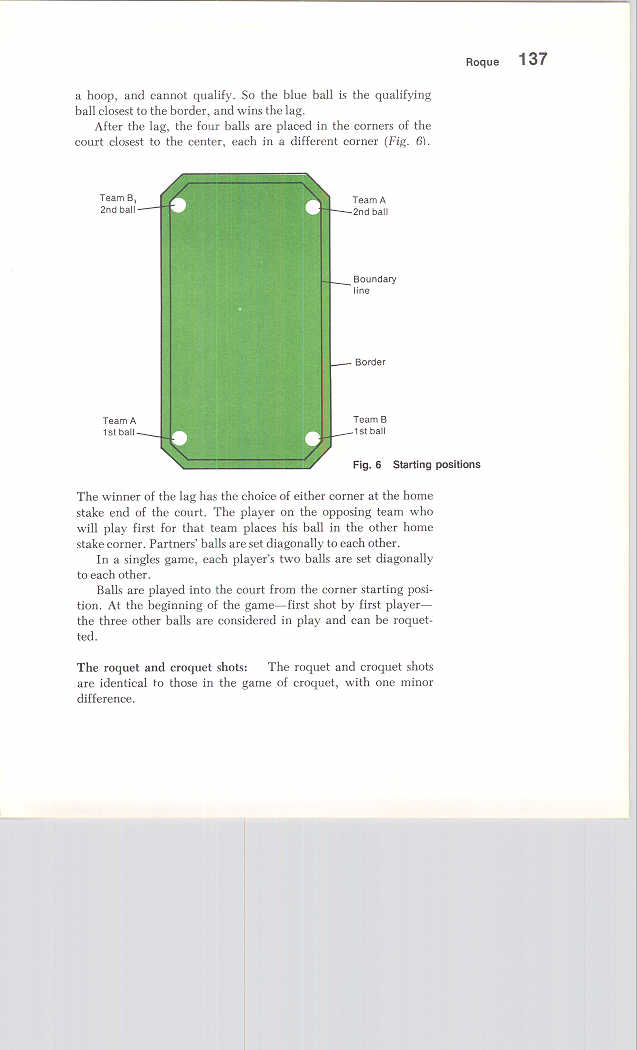
After the lag, the four balls are placed in the corners of the court closest to the center, each in a different corner (Fig. 6).
(Fig. 6 — Starting positions.)
The winner of the lag has the choice of either corner at the home stake end of the court. The player on the opposing team who will play first for that team places his ball in the other home stake corner. Partners' balls are set diagonally to each other. In a singles game, each player's two balls are set diagonally to each other.
Balls are played into the court from the corner starting position. At the beginning of the game—first shot by first player—the three other balls are considered in play and can be roquetted.
The roquet and croquet shots: The roquet and croquet shots are identical to those in the game of croquet, with one minor difference.
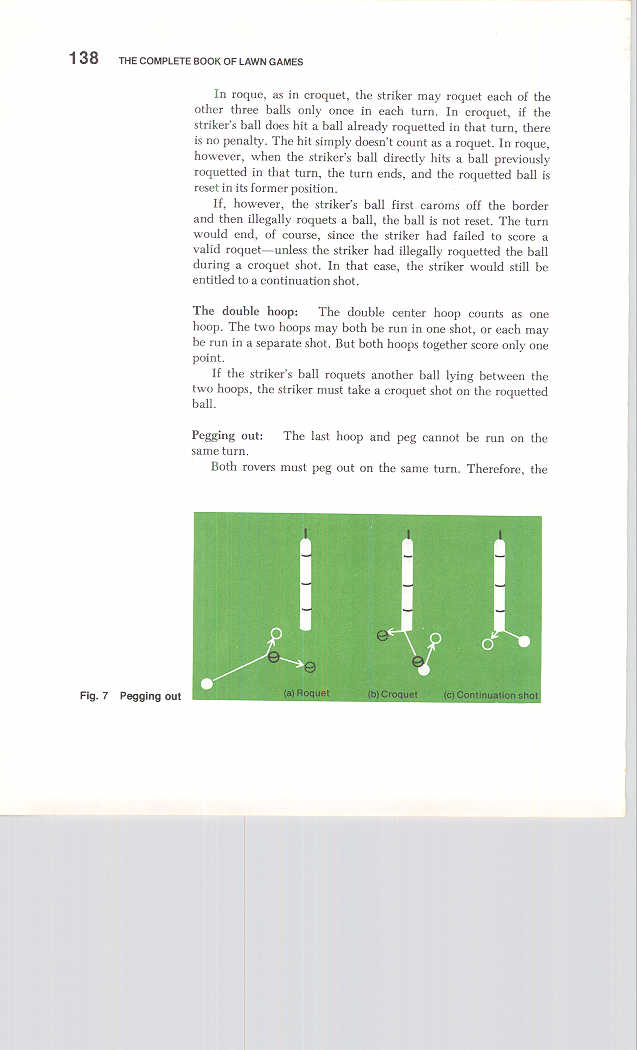
In roque, as in croquet, the striker may roquet each of the other three balls only once in each turn. In croquet, if the striker's ball does hit a ball already roquetted in that turn, there is no penalty. The hit simply doesn't count as a roquet. In roque, however, when the striker's ball directly hits a ball previously roquetted in that turn, the turn ends, and the roquetted ball is reset in its former position.
If, however, the striker's ball first caroms off the border and then illegally roquets a ball, the ball is not reset. The turn would end, of course, since the striker had failed to score a valid roquet—unless the striker had illegally roquetted the ball during a croquet shot. In that case, the striker would still be entitled to a continuation shot.
The double hoop: The double center hoop counts as one hoop. The two hoops may both be run in one shot, or each may be run in a separate shot. But both hoops together score only one point.
If the striker's ball roquets another ball lying between the two hoops, the striker must take a croquet shot on the roquetted ball.
Pegging out: The last hoop and peg cannot be run on the same turn.
Both rovers must peg out on the same turn. Therefore, the… (Fig. 7 — Pegging out.)
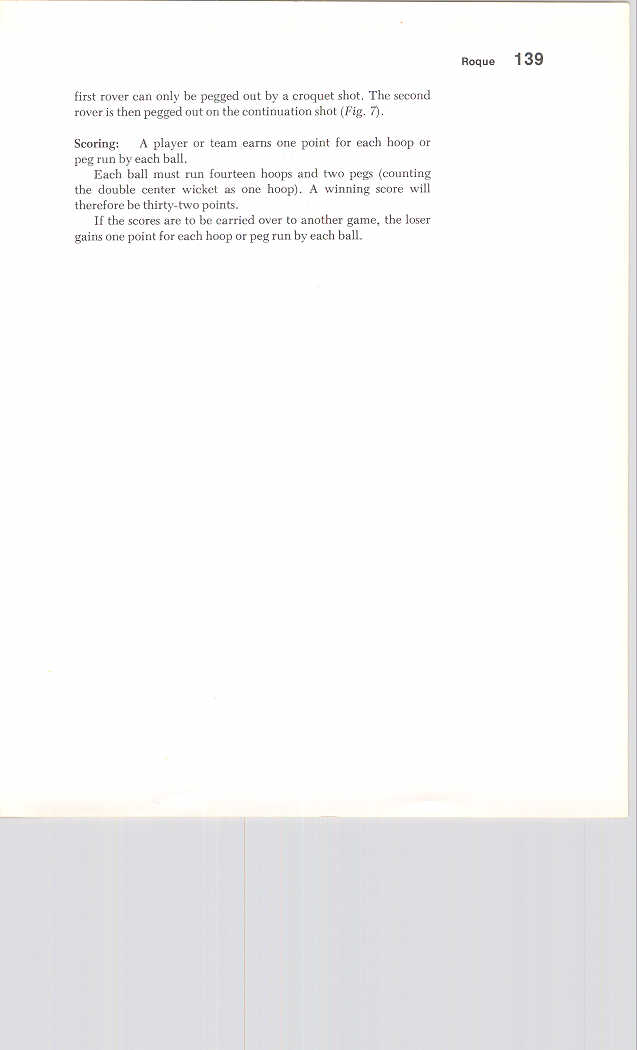
…first rover can only be pegged out by a croquet shot. The second rover is then pegged out on the continuation shot (Fig. 7).
Scoring: A player or team earns one point for each hoop or peg run by each ball.
Each ball counts sixteen points to peg out (counting the double center wicket as one hoop). A winning score would therefore be thirty-two points.
If the scores are to be carried over to another game, the loser gains one point for each hoop or peg run by each ball.
Plates and text from the roque chapter of The Complete Book of Lawn Games, preserved from the austinspring.com archive.
“Roque, the most scientific outdoor sport in existence.”
How it came to America
Croquet has had a very undulating course. It was the popular game of the Royal families of France more than two centuries ago and a little later it became the game of the kings and queens of England. Later it was absolutely lost sight of as a sport except in parts of Ireland where it was kept alive. About 1850 it recrossed the Irish Sea and soon became the most popular outdoor sport in England.
It was little known in America before the year 1870 when for a decade it was played in almost every section of the country, but without organization. At a meeting of representatives from seven clubs, held in New York City on October 4, 1882, the National Croquet Association was organized and the first tournament was held. In 1899 Mr. Samuel Crosby, of New York City, suggested that the letters "C" and "T" be taken from the word "croquet,' thus forming the name "Roque", that the name of the organization be changed to the National Roque Association, and that the game be made thoroughly scientific. Space does not permit the mention of the names of the many men who figured prominently and gave their time and money in the interest of the Association. But as a result of their contributions we have Roque, the most scientific outdoor sport in existence.
The AMERICAN ROQUE LEAGUE was incorporated in the State of Illinois on August 20, 1917.
Its constituent members had been organized since 1911 as the Western Roque Association (not inc.), and this, in turn, was successor to the original Western Roque Association founded at Minneapolis, Minnesota, in 1902. On August 20, 1920, the National Association of America, at its Annual Tournament in Norwich, Conn., by a unanimous vote, united with the American Roque League, as its Eastern Division and adopted the Rules of the League as hereinafter printed. By this action all Roque interests in America were brought together into one organization. The object of the American Roque League is to popularize the game of Roque in America, and pursuant to that end the co-operation of all concerned is solicited.
A short history
Samuel Crosby of New York drops the c and the t from “croquet” — a game meant to be faster and more scientific.
Founded at Minneapolis, one of the roots that would grow into a national body.
At St. Louis, four Americans compete. Charles Jacobus takes gold, Smith Streeter silver, Charles Brown bronze, the sport never appears in the Games again.
Incorporated in Illinois on August 20, gathering the clubs under one charter.
The National Association unites with the League, bringing all of American roque together.
The playing rules preserved on this site are adopted, the ones printed here from the 1958–59 edition.
The American Roque & Croquet Association suspends its national tournament, entries down to single figures.
Clinton, Illinois restores its historic roque court to playing condition, proof a wall can be revived.
Angelica, New York crowns a champion every August, keeping the “Game of the Century” alive.
Fifteen points win a game, each arch run in order, both ways, and the turning stake struck. The League's own scorecard tracked the red, white, blue, and black balls around the court.
Where roque lives on
The name itself was a bet on the future: in 1899 Samuel Crosby of New York dropped the c and the t from “croquet” to coin “roque,” a game meant to be faster and more scientific. It was an Olympic sport in 1904. Then it faded — and in 2004 the American Roque & Croquet Association suspended its national tournament, entries down to single figures. Yet in a handful of towns, the game never stopped.
A clay court sits in the center of the village green in Angelica, Allegany County — one of the very few places roque is still played on a regular basis. The town holds its championship each August, and its winningest player, Jim Gallman, learned the game the old way, watching the elders play across the road from his house.
Proof that a court can come back: Clinton's historic roque court was restored to playing condition in 2013, its walled surface brought back after decades, a rare example of a town choosing to revive the game rather than let the wall crumble.
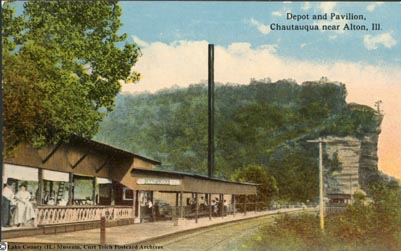
Founded in 1885 on the bluffs above the Mississippi near Elsah, this gated summer Chautauqua is one of the resorts where roque was part of everyday summer life, its two courts sat near the old administration building, within reach of the pavilion and the spring-fed pool. What follows is one family's memory of those summers.
Roque in the world
Roque never really left America, but the mallet-and-ball idea it came from circled the globe. Croquet crossed from French and English lawns; a Japanese variant went on to draw millions. Roque is the walled, hard-court American cousin: the one that burned brightest and briefest.
The parent game, from French and English lawns. Governed today by the World Croquet Federation in two codes — Association and Golf croquet, and played competitively in 20+ countries, chiefly the UK, Australia, New Zealand and the USA.
America's walled, hard-court answer: faster, and “scientific.” Its one Olympic appearance, at St. Louis in 1904, drew only American entrants, the USA swept all three medals. It never crossed the ocean.
Adapted from croquet by Suzuki Kazunobu on Hokkaido in 1947 as a fast team game for young people. Now played by more than 10 million people across 40+ countries, strongest in Japan, China, Korea, Taiwan and Brazil.
Croquet and gateball now stand together under a single banner, the World Federation of Mallet Sports.
A remembrance
Chautauqua, Illinois is where the Frauenthals and Kings had their summer cottages. Grandpa Ed and Grandma Lilian Frauenthal had the cottage where Alice, mom and I stayed. The Kings had a cottage near the end of a road whose name I can't remember. Aunt Ann and Uncle Harold met in Chautauqua, I believe.
Who can forget those idyllic summer days where we played roque, threw horse shoes, played tennis, took fencing classes, and swam every day till we shriveled up. The favorite swimming pastime was a game called “shark.”
The roque courts were down by the road, and everyone knew Dixon. He all but lived at those courts, summer after summer, the finest roque player any of us ever watched.
The children's day pageant was always a highlight with a big parade. On the fourth of July there was a big fireworks display by the Mississippi River. Chautauqua was nestled between two very high bluffs; it felt very protected, with a visitors' gate at one end and the river at the other end. It was surprising that the Air Force named this place as a finalist for the Air Force Academy, it seemed such an unlikely choice.
Most nights we went to the semi-outdoor theater where they had free popcorn, free movies and a community sing. The theater was open on three sides and the kids usually sat up in the front rows. The theater was also the non-denominational Sunday School and a place for plays and musicals.
The town was fed water by an incredible artesian spring that came from the bluffs. It was definitely a “power spot.”
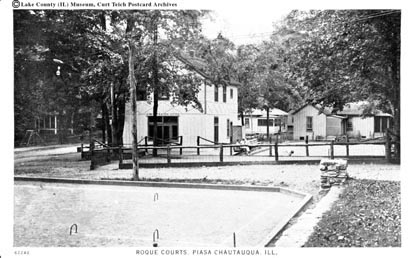
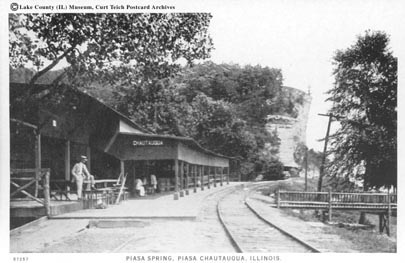
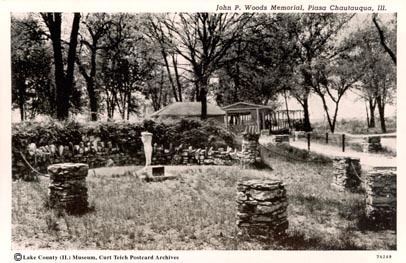
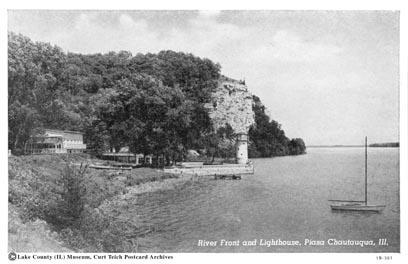
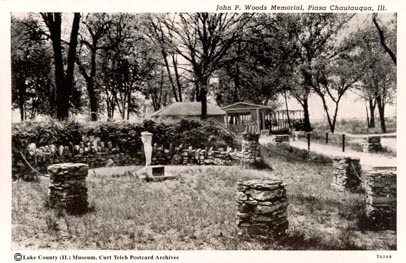
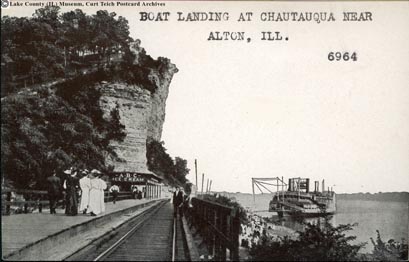
Chautauqua in photographs
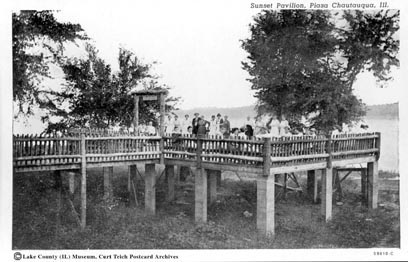
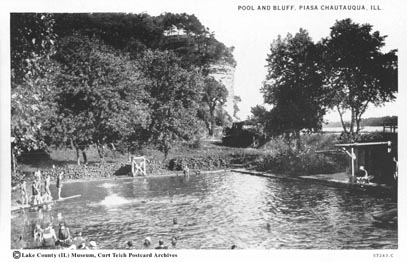
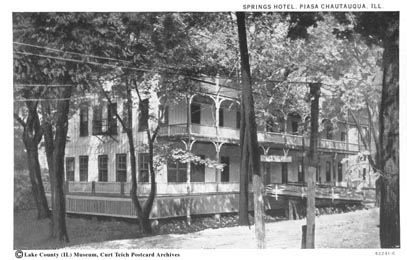
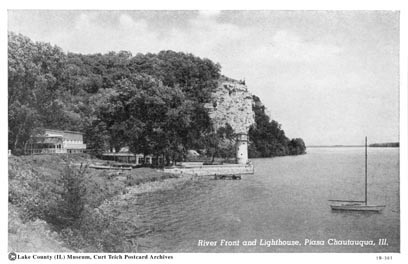
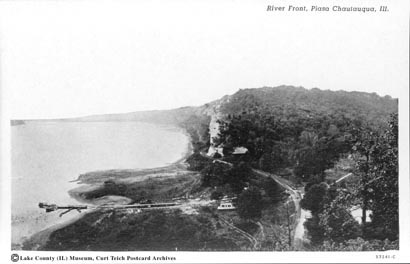
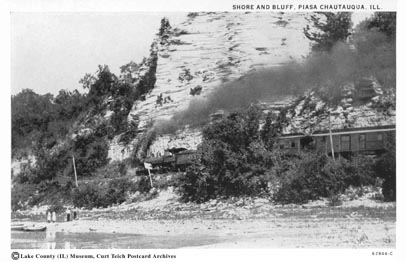
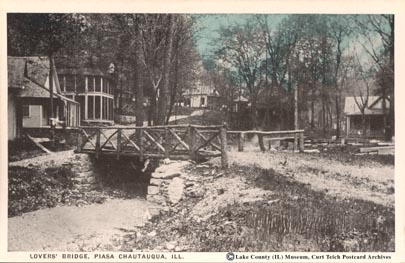
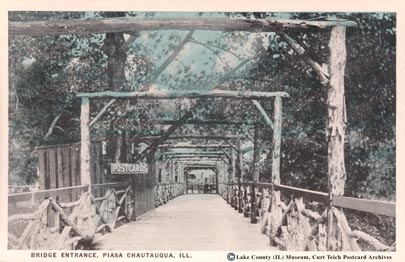
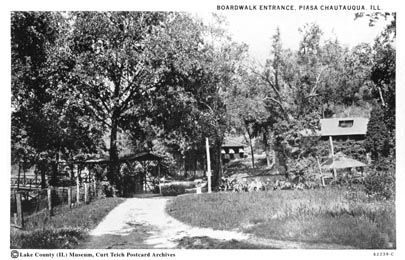
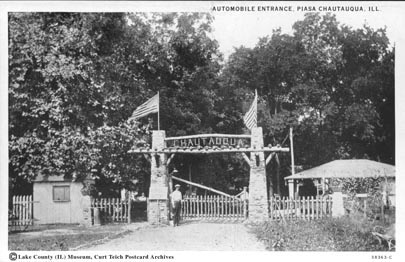
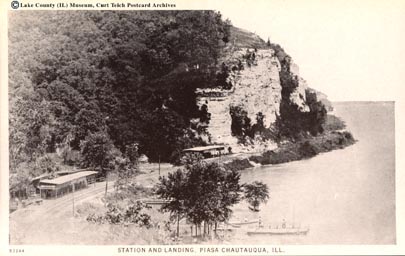
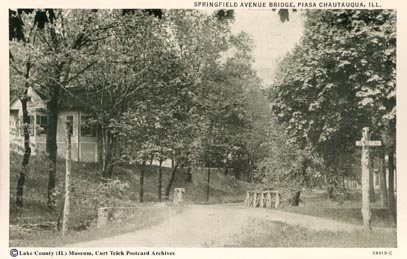
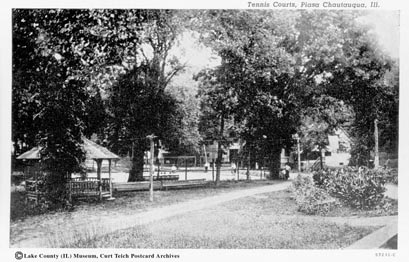
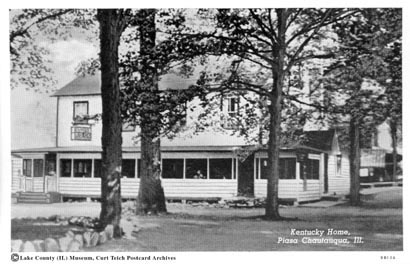
From the album
Old photographs of the resort, the river and the bluffs, the garden, the dinky train, each with Terry's note on what it shows.
New Piasa Chautauqua · 12552 Alton Avenue, Elsah, IL 62028
Roque at Chautauqua
Dixon's courts were no backwater. The annual programs record roque at Chautauqua from the earliest seasons to the 1960s, free sets, a summer-long calendar of elimination games, and a championship crowned each August. Here it is, in the programs' own words.
“There will be two public croquet and roque grounds, in first-class condition… Roque sets will be furnished free.”
Roque is there from the earliest programs.
“ROQUE. Four tournaments, one for gentlemen on Saturday, July 26…”
Named tournaments on a fixed summer calendar.
“The winners of these games are eligible to play for the Roque Cup, at the finish of the season.”
The season builds to the Roque Cup. Chairman: Mr. T. B. Gregory.
Roque Elimination Games most mornings at 9:30–10:00, building to the “Championship Roque Finals.”
Daily play, all season long.
“Few can remember when roque was not played at Chautauqua. Roque courts have been maintained for nearly a half century.”
Championship Day, August 23. Chairmen: Mr. and Mrs. Claude Huss.
“Roque is an old and unique Chautauqua sport… Tournaments for young and old are carried out throughout the season, with champions to be crowned on August 27.”
Still crowning champions, young and old.
Every quote above is in the digitized programs — read them page by page.
Common questions
Roque is an American variant of croquet, played on a hard, sanded court ringed by a solid wall. It uses ten steel arches, two stakes, and four balls, and was billed “the Game of the Century” at its peak in the early 1900s.
Croquet is played on open grass; roque is played on a smooth sanded court enclosed by a permanent wall you can bank shots off, which makes it a game of angles. Roque also uses ten arches and two stakes (croquet uses six hoops), and shorter mallets.
In 1899 Samuel Crosby of New York coined the name by dropping the “c” and the “t” from “croquet,” to signal a faster, more scientific game.
Yes, once. Roque was contested at the 1904 St. Louis Olympics. All four competitors were American; Charles Jacobus won gold, Smith Streeter silver, and Charles Brown bronze. It never appeared in the Games again.
Rarely, but yes. The village of Angelica, New York holds a roque championship every August, and Clinton, Illinois restored a historic court to playing condition in 2013. The national tournament was suspended in 2004 as entries fell to single figures.
A game is 15 points, scored by running each arch in order and both directions and striking the turning stake. Once you’ve made all your points you become a “rover,” lay over one turn, and win the game by contacting your opponent’s ball.
Read every rule
Twelve articles and ninety rules — the court, the equipment, the playing line, fouls, roquet and croquet, and how a game is won.
Open the rulebook